From Toothpaste to Paneer: Counterfeits Have Penetrated India's Homes
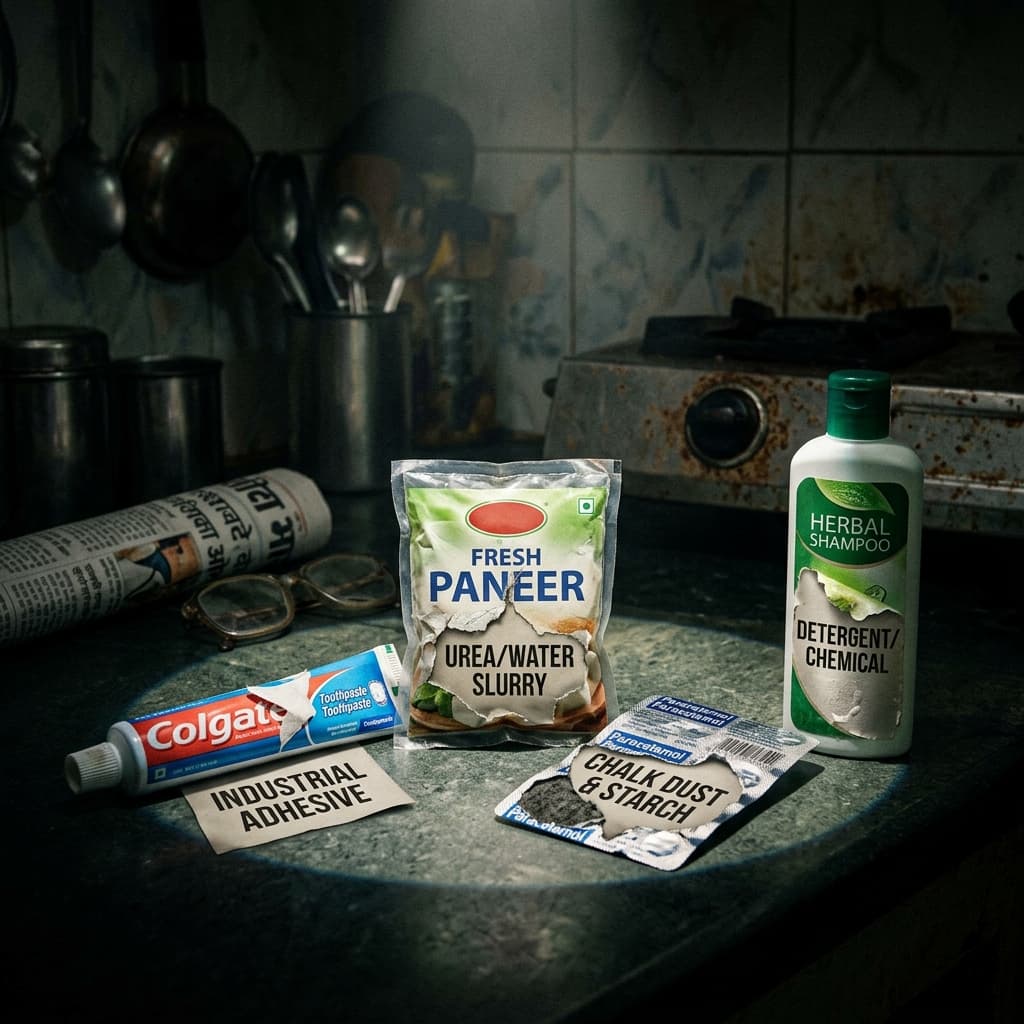
A fake Sensodyne factory in Delhi. Paneer made from palm oil and industrial acid. Fake antacids with no medicine. India's counterfeit economy is no longer a luxury goods problem — it has moved into every Indian home.
StoryRendered18 min read
From Toothpaste to Paneer
Counterfeits Have Penetrated India's Homes
Inside the shadow economy that is hiding in your bathroom cabinet, your kitchen, and your medicine drawer
By: StoryRendered
Published: April 5, 2026
The products look identical. The difference is what's inside — and what it does to you.
The Trigger: A Factory Busted in Delhi
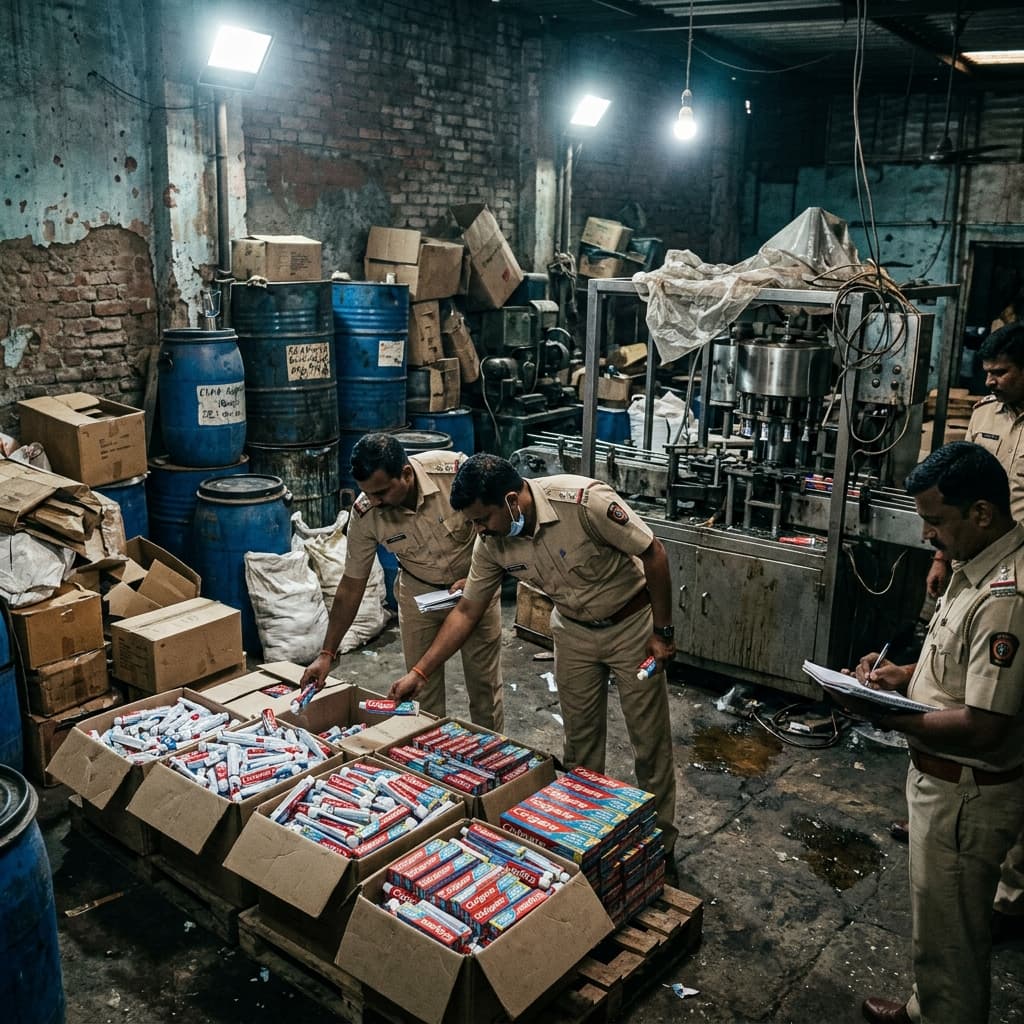
The story crystallized on April 2–3, 2026, when Delhi Police's Crime Branch raided a godown in the Mahaveer Vihar locality of northwest Delhi's Kanjhawala area. What they found inside was not just illegal — it was a near-perfect replica of a legitimate manufacturing operation, down to the Sensodyne branding on tens of thousands of toothpaste tubes.
The operation was led by Inspector Ashish Sharma, under the supervision of ACP Sunil Srivastava and DCP Pankaj Kumar.
🪥
1,800+
Filled Fake Tubes Seized
📦
10,000+
Empty Tubes Recovered
⚗️
130 kg
Counterfeit Paste Bulk
Factory owner Hariom Mishra, 58, was arrested. During interrogation, he admitted to running the operation from a rented warehouse and supplying the counterfeit products to local markets. Investigators described conditions in the facility as hazardous — chemicals mixed in open containers, packaging done without any sanitary controls, in a space that bore no resemblance to the clinical environment of a genuine toothpaste factory.
The Kanjhawala raid. Officers found nearly perfect packaging replicas — only the contents were dangerous.
Not Luxury Goods — Your Daily Essentials
What makes this wave of counterfeiting particularly alarming is the shift in target. This is no longer a problem confined to designer handbags, fake watches, or pirated DVDs. A cascade of raids across Delhi over the past two years has revealed a disturbing expansion: counterfeiters have moved into the everyday essentials that every Indian household depends on.
🔴
Scale of the Problem
Since 2023, Delhi Police have unearthed 740 cases related to the production and sale of fake goods. From January to September 2025 alone, 132 cases were registered under the Copyright Act.
The product list from recent raids reads like a household shopping list:
Fake Ghee: Police in Alipur recovered around 1,500 kg of spurious desi ghee, packed in tins mimicking popular brands. A follow-up unit in Bawana Industrial Area was busted with thousands of litres of adulterated ghee stored in open, unhygienic drums. The method: cheap vegetable oil blended with synthetic aroma chemicals designed to smell like genuine dairy.
Fake Medicines: The most disturbing crackdown uncovered a unit manufacturing fake antacid sachets — the type millions of Indians consume daily. Officers seized nearly 1 lakh packets along with raw powders, packaging rolls, and sealing machines. The packaging was nearly identical to leading brands. Laboratory analysis confirmed the fake antacids contained none of the correct medicinal compounds — meaning a person reaching for relief during a stomach emergency would get nothing but unspecified chemicals.
Fake Toothpaste, Shampoo, and Detergents: A northeast Delhi raid yielded over 18,000 fake toothpaste tubes and chemicals ready for filling. A separate Rohini unit was producing counterfeit shampoo, detergent, soap, and floor cleaners using fake holograms and brand labels — supplied to wholesale markets at aggressively cheap margins.
Fake Drinking Water: Two men were arrested for selling fake packaged drinking water, filled from borewell sources and marked with forged trademark stickers.
The Paneer Crisis: India's Most Adulterated Food
Of all the counterfeit goods circulating in India, none has attracted more regulatory alarm than fake paneer. Between April 2024 and March 2025:
🧪
83%
Paneer Samples Failed Safety Tests
Across India
☠️
40%
Found Unsafe for Consumption
Tainted with harmful chemicals
🏭
4,000 kg
Seized by FSSAI Nationwide
In a single crackdown operation
Analogue paneer — the industry term for the fake variety — is a sophisticated substitute. It costs nearly half the price of genuine dairy paneer to produce, while maintaining similar taste and texture. But unlike real paneer, it is made from emulsifiers, starch, and low-quality vegetable oils, with no milk involved.
What Goes Into Fake Paneer
The composition varies by producer, but common ingredients found in laboratory analyses include:
Starch to bulk up the volume
Vanaspati ghee or palm oil as fat substitutes
Detergent and washing soda to improve whiteness
Synthetic milk solids engineered to mimic dairy proteins
The Agra Case
UP food safety officials raided a large-scale operation in Agra producing paneer from palm oil, diluted milk, and industrial chemicals. The economics were stark: adulterated paneer was being produced for ₹150/kg, sold to urban dairies for ₹220/kg, and then retailed at ₹320–₹350/kg — a supply chain built entirely on fraud, capitalising on peak wedding-season demand.
The Surat Case
In Surat, 1,400 kg of suspected paneer seized from Pandesara was declared "sub-standard" by the Surat Municipal Corporation. Laboratory tests found vegetable oil and traces of industrial acetic acid — the type used in manufacturing, not food preparation. The unit reportedly produced around 400 kg of fake paneer daily, supplying small dairies, eateries, and street food vendors.
The UP Crackdown
UP's Food Safety and Drug Administration busted rackets across Gorakhpur and Gautam Buddha Nagar, seizing 2,500 kg of adulterated paneer, 800 litres of contaminated milk, and 13,076 litres of fake packaged water — all destroyed on site.
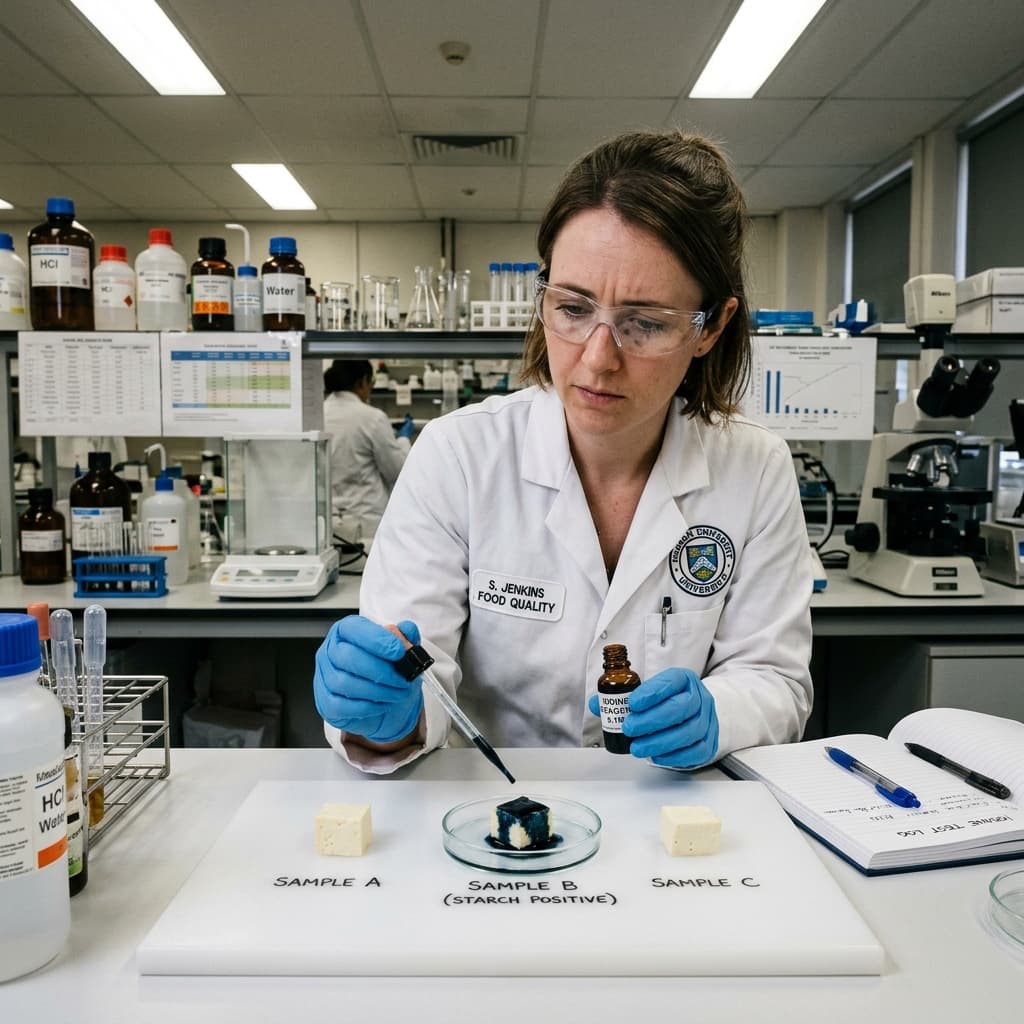
The iodine test never lies. Blue-black colouration confirms starch — the most common adulterant in fake paneer.
How to Identify Fake Paneer at Home
FSSAI and food safety officials have issued simple field tests that any consumer can perform:
Three Tests Every Consumer Should Know
1. The Iodine Test
Crush a small paneer sample and add a few drops of iodine solution. A blue or black colouration indicates starch — a hallmark of adulterated paneer.
2. The Hot Water Test
Drop a piece of paneer into hot water. If it breaks apart easily, or leaves an oily or soapy residue, adulteration is likely.
3. The Texture Check
Real paneer feels firm yet soft and springy. A rubbery, overly smooth, or plastic-like texture may indicate synthetic materials.
Price Alert: Genuine paneer sells for ₹400–₹450/kg. Analogue versions often circulate at ₹180–₹250/kg. If the price seems too good to be true — it almost certainly is.
Health Dangers: What Fake Products Do to You
Fake Toothpaste
Counterfeit toothpaste can contain industrial-grade detergents, abrasive compounds, and colouring agents not approved for human use. Prolonged use can lead to oral infections, accelerated tooth erosion, gum disease, and long-term dental complications affecting both enamel and soft tissue.
Fake Paneer
⚠️
Doctors' Warning
Because paneer is frequently consumed raw in salads or lightly cooked in curries, any toxic compounds present in adulterated versions remain largely active — entering the bloodstream with minimal resistance.
Long-term risks: Kidney and liver dysfunction, hormonal disruption, and cumulative toxicity from repeated exposure to synthetic chemicals — especially dangerous for children and the elderly.
The Big Picture: A National Counterfeiting Crisis
The most authoritative data comes from the "State of Counterfeiting in India 2025" report by the Authentication Solution Providers' Association (ASPA) and CRISIL Intelligence, released at the TAF Connect 2026 conclave in March 2026. The study surveyed 1,639 respondents across nine major Indian cities.
🛒
35%
Encountered Fakes in the Last Year
Based on ASPA-CRISIL Survey
👤
9/10
Urban Consumers Bought a Fake At Least Once
Lifetime purchase rate
📊
29%
Products in Local Markets Estimated to be Counterfeit
Between 2018 and 2025, reported counterfeiting cases in the FMCG industry alone total 1,022 incidents — an approximate 2.5× increase from 2018 levels.
Where You Are Most at Risk
Online platforms account for 53% of counterfeit purchases — the single largest channel.
Local retail dominates for agro-products (75%) and pharmaceuticals (63%).
Social media ads are an emerging vector, especially for apparel (46%) and electronics (35%).
The Geography of Counterfeiting
💡
Where Most Cases Are Reported
From 2018–2025, Uttar Pradesh recorded the highest volume of counterfeiting cases nationally, followed by Rajasthan and Madhya Pradesh. Together, these three states account for approximately 46% of all counterfeiting incidents reported in India.
The Economic Impact
The counterfeit market is growing at an estimated 15–20% annually.
💸
$58.7B
Annual Economic Loss
Cost to India's economy
🏦
$16.2B
Annual Tax Revenue Loss
Government revenue impact
On average, counterfeit FMCG products are priced 19% cheaper than their genuine counterparts — just enough to be attractive, not enough to be suspicious.
Why Counterfeiting Keeps Thriving
India's vast, fragmented retail network — millions of small shops, informal distributors, weekly street markets — is structurally impossible to police comprehensively. Counterfeiters understand this better than anyone.
The inspectors gap is catastrophic. In Delhi, 34 food safety inspector posts were created in the late 1970s. That number has never been updated for a city that now has over 2 crore residents — and most of those posts are currently vacant. Only 22 food inspectors currently serve Delhi. Uttar Pradesh, with a population of 20 crore, has only 750 food safety officers.
Counterfeiters are also getting faster at replicating brand signals. Modern printing and packaging technology means fake labels, holograms, and barcodes are now accessible, affordable, and nearly indistinguishable from genuine packaging. In many cases, even the retailers selling counterfeit goods may not be aware of what they are handling.
What Is Being Done — and What Is Needed
Authorities are now attempting to map distribution channels to remove batches already in circulation. FSSAI released a consultation paper in April 2025 inviting stakeholder input to formally define and regulate the "analogue dairy" market — a long-overdue regulatory response to the fake paneer epidemic.
At the TAF Connect 2026 conclave, Rajesh Kumar Mishra of the Indian Institute of Packaging stated:
The scale of counterfeiting in India is not a business problem alone — it is a national security and public health emergency. Packaging and authentication technologies are among our strongest weapons, and we must deploy them at scale.
Experts across sectors now call for:
Mandatory QR-code verification on all food and pharma packaging
Real-time supply chain tracking integrated with GST systems
Harsher criminal penalties with mandatory jail time for repeat offenders
Dramatic expansion of FSSAI inspection infrastructure
Consumer attitudes are also slowly shifting. 50% of consumers now say they would file a complaint if they received a counterfeit product — a sign of growing intolerance that gives enforcement agencies more to work with.
The Bottom Line
The fake Sensodyne bust in Delhi is not an isolated incident. It is a window into a sprawling, deeply entrenched shadow economy that has quietly moved into every Indian home —the toothpaste in your bathroom, the paneer in tonight's curry, the antacid in your medicine drawer, the water in the bottle your child is drinking from.
🔴
The Systemic Reality
Counterfeit products are no longer rare exceptions in India. They are part of everyday consumption. The solution demands coordinated urgency from consumers, retailers, manufacturers, and the state — because what is at stake is not brand protection. It is public health.
Sources: Delhi Police Crime Branch, FSSAI, ASPA–CRISIL "State of Counterfeiting in India 2025", FICCI CASCADE Report 2024, UP Food Safety and Drug Administration, Surat Municipal Corporation.