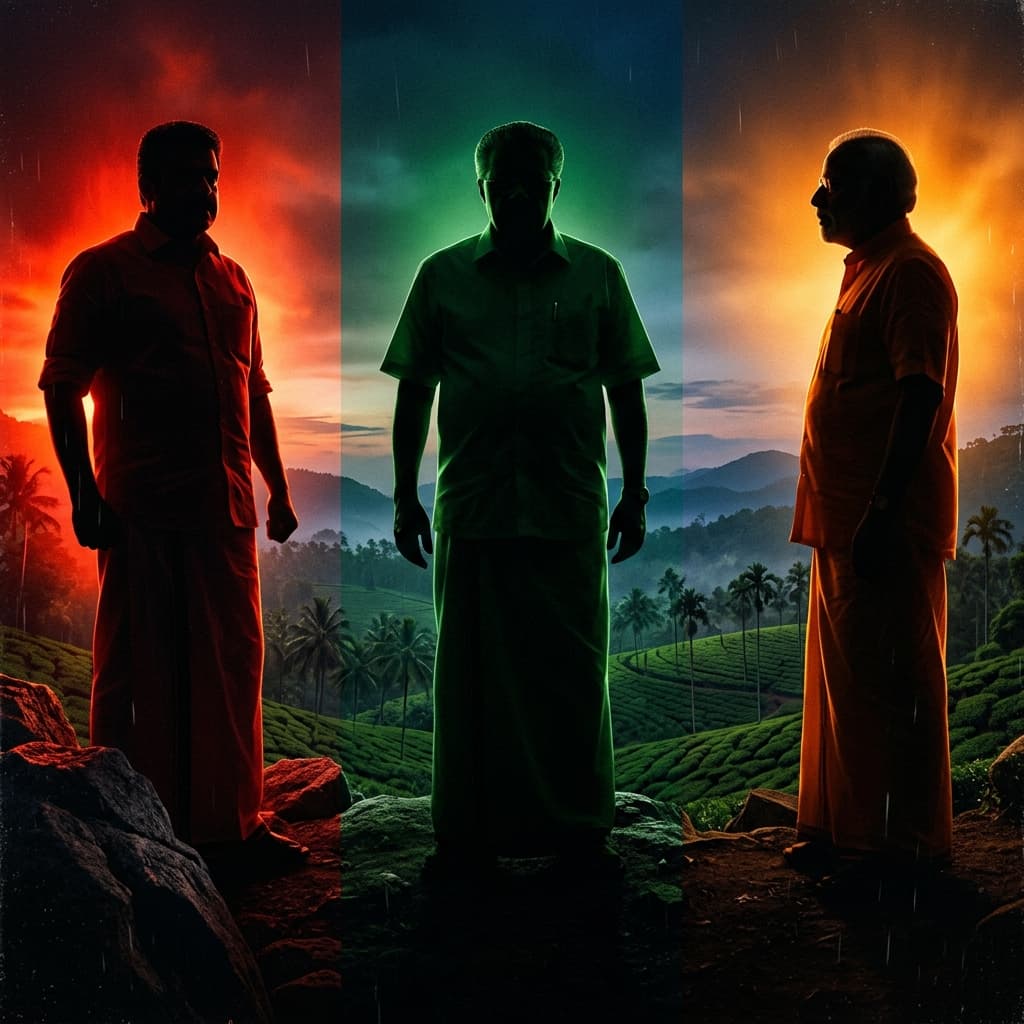
Tamil Nadu Assembly Election 2026: The Complete Guide
Everything you need to know about the most unpredictable Tamil Nadu election in a generation — History, Alliances, Manifestos, and Demographics.
StoryRendered22 min read
Tamil Nadu Assembly Election 2026
The Complete Guide
Everything You Need to Know — History, Alliances, Manifestos, Issues, Demographics, Campaigns & What's at Stake
By: StoryRendered
Published: April 2, 2026
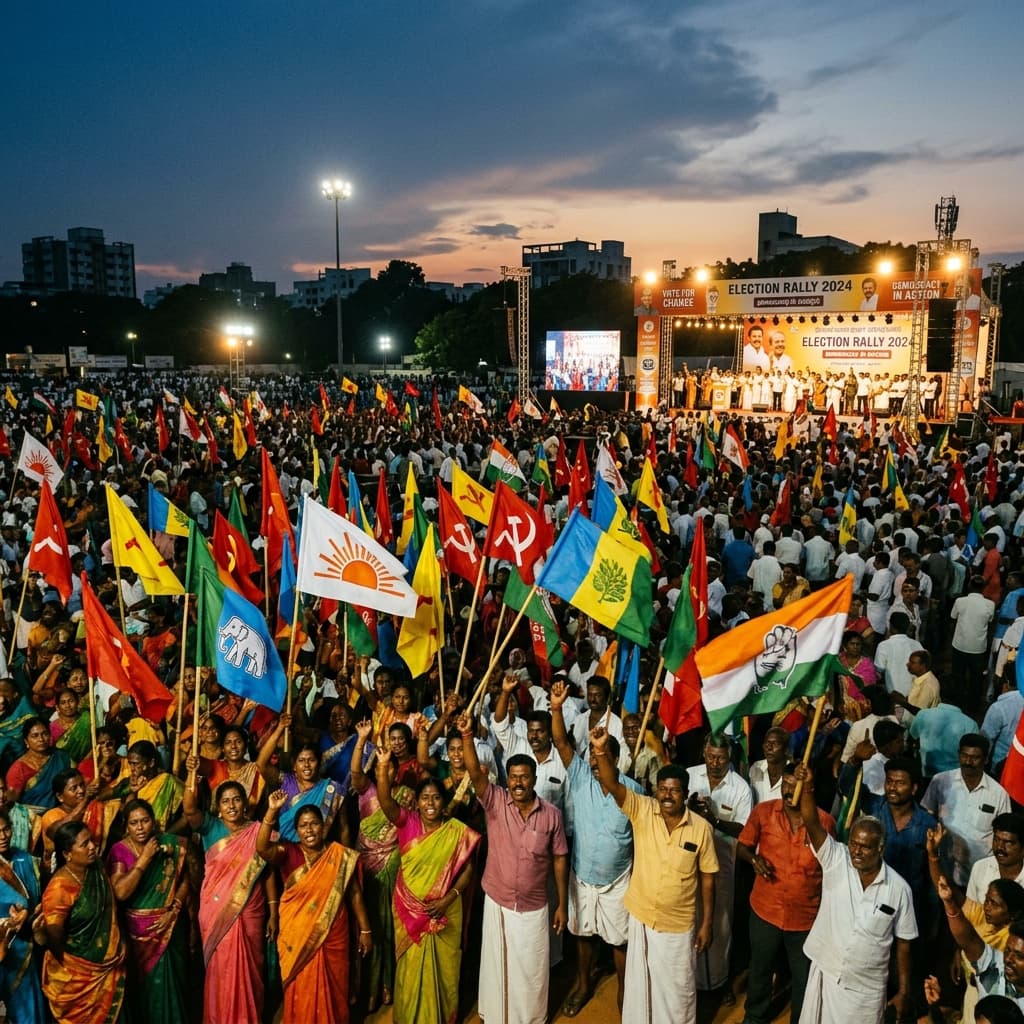
The 2026 campaign trail.
Why This Election Is Unlike Any Other
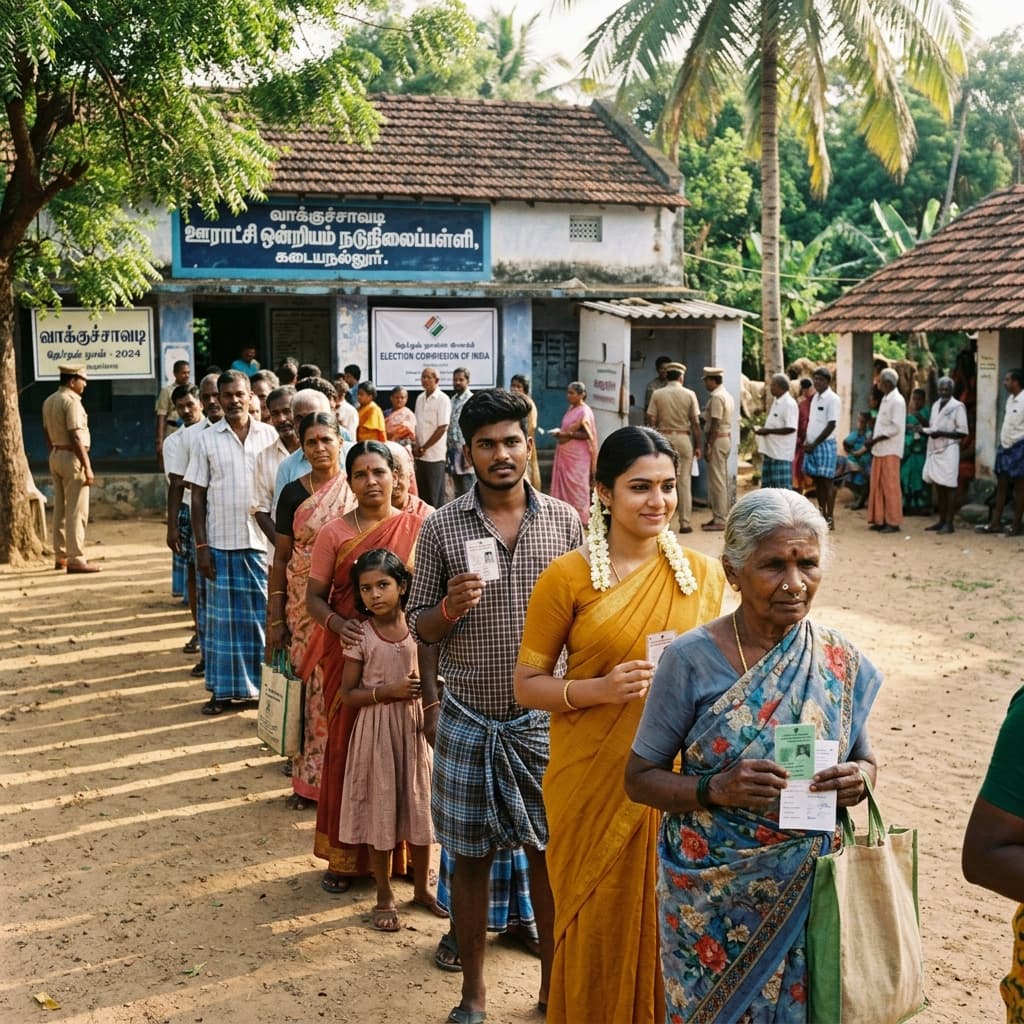
Tamil Nadu votes on April 23, 2026. On the surface, it looks like another five-year cycle in India's southernmost major state — 234 constituencies, two big Dravidian parties, a few allies, and a winner takes all. But look closer and something is unmistakably different.
For the first time in five decades, Tamil Nadu is not a two-party race. A film star has quit the screen and entered the ballot. An alliance that collapsed in disgrace in 2024 has been stitched back together and is claiming it can form a government. A sitting Chief Minister is asking voters to break the state's most stubborn political habit — throwing out the incumbent — and return him to power for a second consecutive term. And a Tamil nationalist force that was polling 1% in 2016 has grown to 8% and is running candidates everywhere.
This is the most fragmented, the most unpredictable, and arguably the most consequential election in Tamil Nadu in a generation. The outcome will decide not just who governs 77 million people — it will determine whether the Dravidian duopoly that has defined South Indian politics since 1967 can survive a generational assault, whether the BJP can finally crack Tamil Nadu's cultural resistance, and whether celebrity translates into real political power.
🏛️
234
Assembly Seats
✅
118
Majority Mark
🗳️
5.67 Cr
Eligible Voters
🏫
75,032
Polling Booths
[!IMPORTANT]
Election Schedule: The Election Commission of India announced the schedule on March 15, 2026. Voting takes place in a single phase on April 23, 2026, with counting and results scheduled for May 4, 2026.
59 Years of Dravidian Politics (1967–2021)
Tamil Nadu has conducted 16 assembly elections since independence. Understanding this history reveals the patterns — anti-incumbency, the rise and fall of dominant leaders, and the emergence of new forces.
From 1989 to 2011, DMK and AIADMK strictly alternated power — not once did the same party win back-to-back. Jayalalithaa broke that pattern in 2016. Stalin is now trying to break it again in 2026.
1967
The Revolution: DMK Ends Congress Rule
A political earthquake. The anti-Hindi agitation of 1965 driven into votes by C. N. Annadurai. The DMK wins 138 seats ending 20 years of Congress dominance. Congress has not won Tamil Nadu on its own since.
1971
DMK's Greatest Triumph
M. Karunanidhi sweeps the state with 184 seats and a 48.58% vote share — records that stand to this day. This is the last time the DMK was re-elected consecutively.
1977-1984
MGR and the AIADMK Era
After splitting from the DMK, film star MGR leads the AIADMK to three consecutive terms (1977, 1980, 1984), creating a welfare state model that every party emulates today.
1989-1996
The Swinging Pendulum
Following MGR's death (1987), Karunanidhi returns to power in 1989. Jayalalithaa sweeps to a landslide in 1991. Anti-incumbency hands the DMK a massive mandate in 1996.
2001-2011
The Alternating Decades
The two parties strictly alternate. Jayalalithaa wins in 2001 and 2011 (a clean sweep 203 seats over 2G scam backlash). Karunanidhi wins his final term in 2006.
2016
Jayalalithaa's Historic Win
Jayalalithaa breaks the anti-incumbency pattern, winning back-to-back terms with 136 seats before tragically passing away just six months later.
2021
Stalin's Moment
End of an era. With both Jayalalithaa and Karunanidhi gone, M. K. Stalin leads the DMK Secular Progressive Alliance to 159 seats, becoming Chief Minister at 68.
2026 Alliances & The New Battlefield
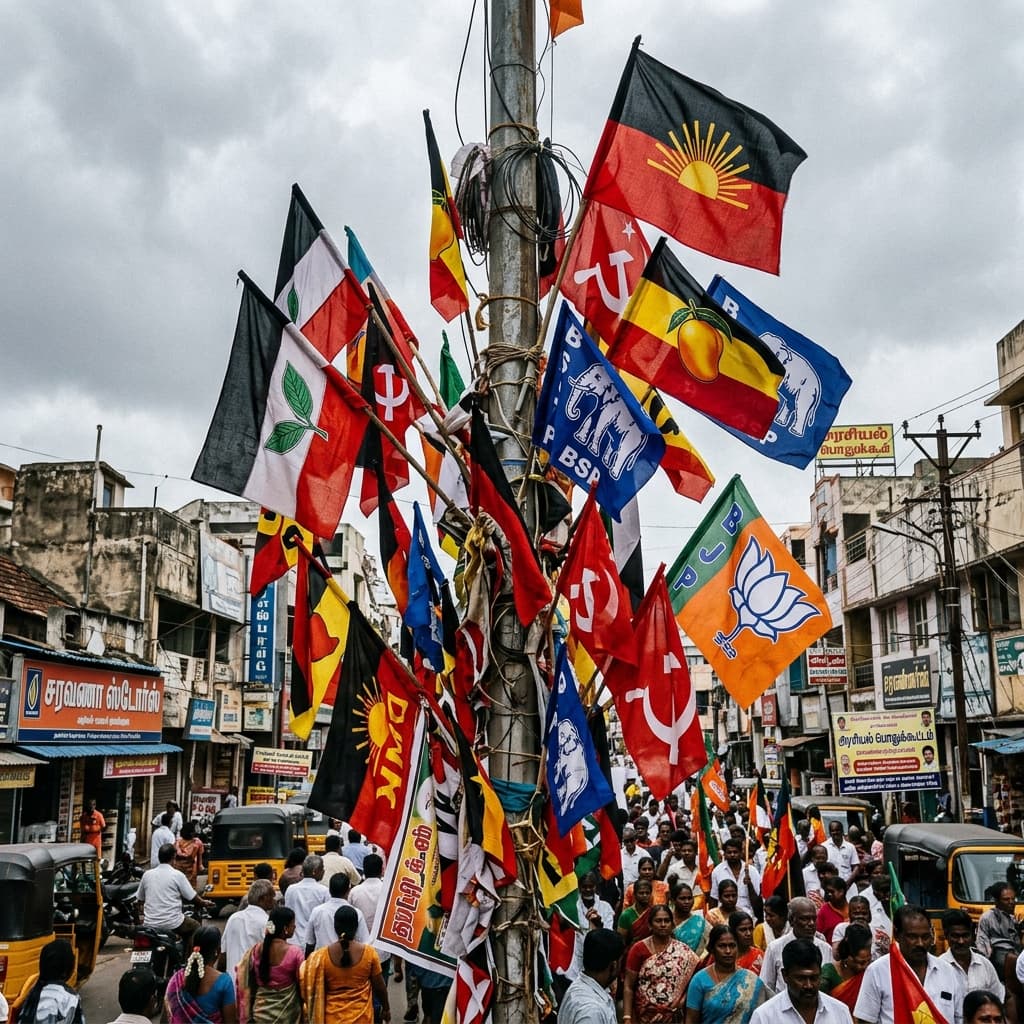
This is the most contested battlefield in recent history. The traditional bipolar DMK vs AIADMK race is now fractured multi-directionally involving TVK, NTK, and a fierce wild-card grouping.
Political fragmentation is at an all-time high in 2026, with an unprecedented four to five-way split.
The Duopoly Fronts
1. DMK-Led Secular Progressive Alliance (SPA)
CM Candidate: M.K. Stalin | Target: Breaking 55-year anti-incumbent streak
DMK: 164 seats
INC: 28 seats
DMDK: 10 seats
VCK: 8 seats
CPI/CPM: 5 seats each
MDMK: 4 seats
The DMK relies heavily on defensive record narrative, citing immense welfare deliveries, paired with an aggressive "Tamil Nadu vs. Delhi" posture protecting state federalism.
2. AIADMK-Led National Democratic Alliance (NDA)
CM Candidate: E.K. Palaniswami | Target: Reclaiming former glory alongside BJP
AIADMK: 169 seats
BJP: 27 seats
PMK: 18 seats (Anbumani faction)
AMMK: 11 seats
TMC: 5 seats
Having survived devastating splits, Palaniswami reunited with the BJP in April 2025. Their campaign ruthlessly attacks DMK over law & order, inflation, and alleged corruption (citing the Senthil Balaji case). The BJP, polling around 11% earlier, claims the alliance will form the government.
The Disruptors
🔴
The Wild Card: Vijay's TVK (Solo)
On March 18, 2026, Tamil superstar C. Joseph Vijay announced his Tamilaga Vettri Kazhagam (TVK) will contest all 234 seats independently. Targeting the 40% youth demographic (2.28cr voters aged 20-40) digitally, they bypass traditional structure. Vijay's explicit aim is to unseat the DMK in a "generational election/whistle revolution."
However, his campaign suffered a major blow following a crowd crush in Karur resulting in 41 deaths. Observers are closely watching to see if Vijay avoids the "DMDK 2016 fate" where celebrity fails to convert into booth-level votes.
Naam Tamilar Katchi (NTK), led by Seeman, continues its slow but iron-clad growth (from 1% in 2016 to 8% in 2024 Lok Sabha), contesting solo on strict Tamil cultural sovereignty.
The Sasikala + PMK(R) Wildcard Front threatens to drain vital Thevar and Vanniyar votes from the AIADMK alliance via residual Jayalalithaa loyalty and Vanniyar splintering.
Voter Demographics
Women voters now outnumber men in Tamil Nadu, structurally reshaping the manifestos of every party involved.
2.89 Cr
Women Voters
51% (Outnumbers Men)
2.28 Cr
Youth (20-40)
40% of Electorate
44,065
Rural Booths
59% (Core Base Grids)
12.5L
First Time Voters
Prime TVK Target
Regional Geography & Caste Impact
Tamil Nadu's 2026 political geography is severely divided:
Northern TN (Tondaimandalam) [~55 seats]: Heartland of the Vanniyars. A PMK splinter severely impacts NDA odds. Chennai (urban) faces strong anti-incumbent youthful energy targeting DMK.
Western TN (Kongu Nadu) [~50 seats]: Traditional AIADMK stronghold relying on Kongu Vellala Gounder loyalty. But DMK welfare operations are systematically slicing into margins in Coimbatore/Erode.
Southern TN (Pandya Nadu) [~60 seats]: Incredibly volatile. The Mukkulathor (Thevar) vote is divided 3 ways between EPS (AIADMK), OPS (now DMK), and TTV Dhinakaran (AMMK).
Central TN (Cauvery Delta) [~41 seats]: The "Rice Bowl" and DMK's absolute stronghold, bolted down alongside VCK's powerful Dalit consolidation.
Key Issues & Manifestos
A Vote Vibe survey revealed brutal concerns:
Alcoholism & Drug Menace (19.9%)
Women's Safety (18.3%)
Law & Order (18.2%)
Focus: "The Superstar Manifesto"
Released on March 29, DMK's Stalin presented 525 promises focused on "smart economic multipliers".
Raises the Magalir Urimai Thogai (women's entitlement) to ₹2,000/month.
Offers a massive ₹8,000 "Illatharasi" homeware coupon.
Free electric pump sets, 35 lakh free laptops, and sweeping job creation.
Focus: NDA Counter
The AIADMK matched the ₹2,000 women's monthly aid, threw in a ₹10,000 relief payment to fight inflation, and proposed extending the wildly popular free bus travel scheme to men.
Focus: Whistle Revolution
Vijay's TVK manifesto completely ignored traditional promises to target youth: Anti-drug zones across the state, ₹20L collateral-free startup/education loans, strict exam transparency, and incubators in all districts.
Opinion Polls & The Anti-Incumbency Threat
Vote Vibe surveys state 41.9% of voters rate DMK's governance as poor/very poor against 36.1% positive. DMK approval is split completely: immense praise for direct cash/bus transfers versus fury over costs of living, corruption perception (53% think it increased), and dynastic frustration (Udhayanidhi Stalin's rapid ascension).
In a two-party system, angry voters flock to the opposition. In 2026, an angry voter can choose AIADMK, TVK, NTK, or Sasikala. If anti-DMK votes shatter 4 ways, DMK's massive baseline may allow them to walk through the cracks and hold power. However, with 15.6% of voters entirely undecided, a "hung assembly" (which Tamil Nadu has never experienced) has analysts on extreme edge.
Battles to Watch
Perambur: Vijay vs DMK veteran R.D. Sekar in the heart of North Chennai.
Coimbatore South: DMK throws controversial former minister Senthil Balaji directly at the BJP's only reliable stronghold.
Chepauk: Deputy CM Udhayanidhi Stalin races his own anti-nepotism shadow.
Bodinayakanur: OPS attempts physical rehabilitation within the DMK against his old AIADMK loyalists.
What's At Stake?
This election dictates the survival of the Dravidian core. It will prove if Vijay's sacrifice of his historic film career translates to real governance. It determines if India's ruling party, the BJP, can finally shatter Tamil Nadu's anti-Hindi, secular firewall.
But most immediately, it answers the question of whether M.K. Stalin has enough welfare armor to survive Tamil Nadu's deeply entrenched habit of destroying incumbencies. On May 4th, 2026, the counting begins.
Disclaimer: Opinion polls and data projections sourced from Vote Vibe, Chanakyaa TV, IPDS, and Parawheel are snapshots of voter sentiment prior to election conclusion.
 Politics