266 Million on the Brink: The Global Hunger Crisis of 2026
For the first time in recorded history, two simultaneous famines — in Gaza and Sudan — have been confirmed in the same year. A deep investigation into the 2026 Global Report on Food Crises reveals how 266 million people reached the edge of starvation, and why the world's response is failing.
StoryRendered18 min read
266 Million on the Brink
The Global Hunger Crisis of 2026 — A Deep Investigation
By @storyrendered · Source: Global Report on Food Crises 2026 (GRFC), IPC, FAO, WFP, UNICEF
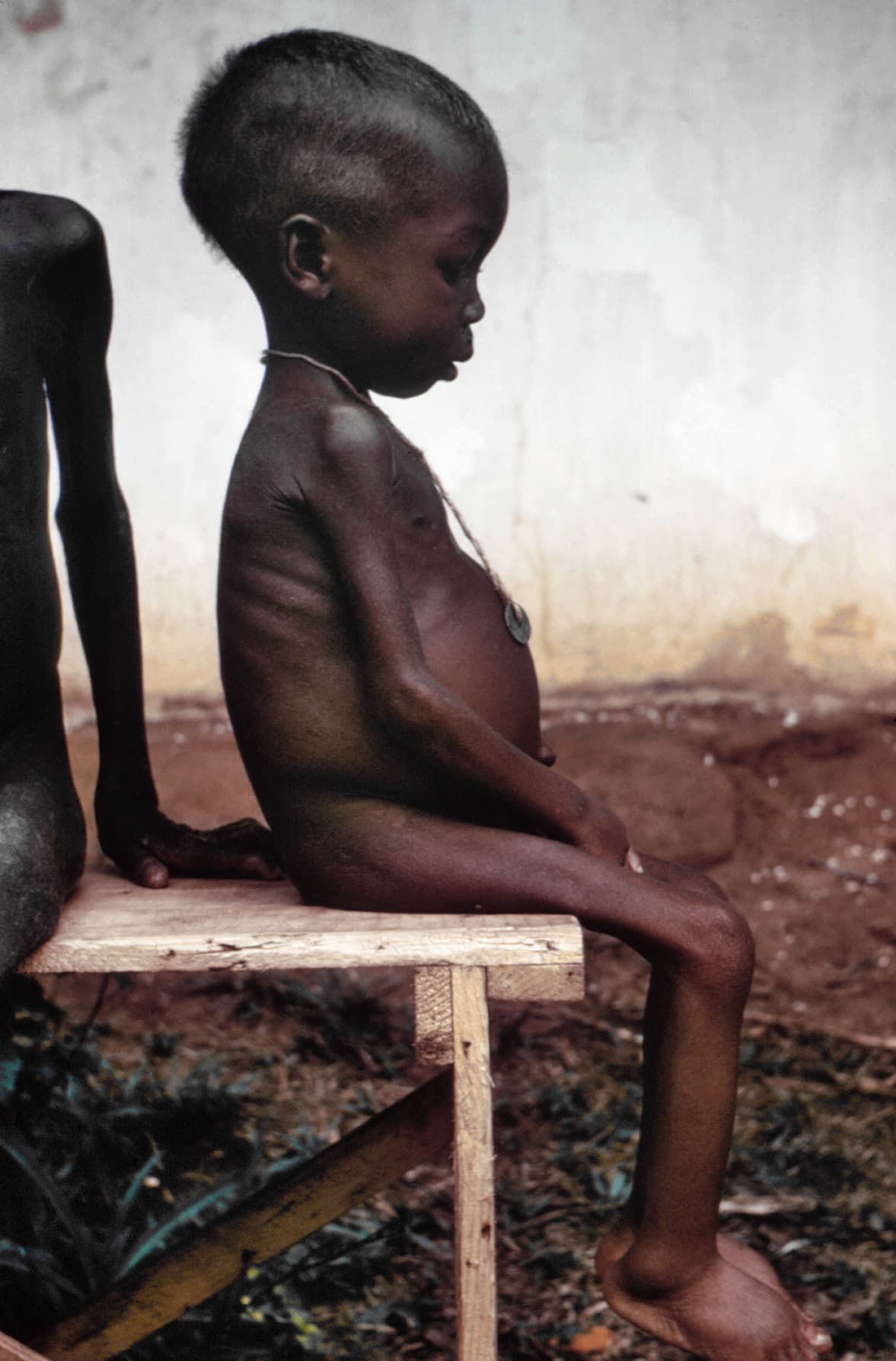
Acute malnutrition affects an estimated 35.5 million children across 23 countries. For millions, survival depends entirely on humanitarian aid that is being systematically cut.Dr. Lyle Conrad / CDC / Public Domain
🌍
266M
Acutely Food Insecure
People across 47 countries facing acute hunger in 2025
💀
1.4M
In Catastrophe
IPC Phase 5 — one step away from death. A ninefold rise since 2016
🧒
35.5M
Children Malnourished
Acutely malnourished children across 23 countries
📉
39%
Funding Collapse
Drop in humanitarian food-sector funding in 2025
Introduction: A Record That Should Never Have Been Set
The year 2025 broke a record that no one wanted to see broken.
According to the 2026 Global Report on Food Crises (GRFC) — the world's most authoritative annual assessment of acute hunger — 266 million people across 47 countries faced acute food insecurity in 2025. That figure represents approximately 23% of all people analyzed across the globe. It marks the second-highest severity ever recorded.
But the raw numbers obscure something far more alarming: for the first time in the modern era of famine monitoring, two simultaneous famines were confirmed in the same year. Gaza and Sudan, two conflict zones thousands of miles apart, each tipped into famine conditions while the international community watched with inadequate response.
At the most severe end of the hunger spectrum — what the Integrated Food Security Phase Classification (IPC) calls Phase 5, or "Catastrophe" — 1.4 million people were found to be in famine-like conditions. This is a ninefold increase from 2016, when just 150,000 people were classified at this level. Acute hunger has not merely grown over the past decade. It has doubled.
🔴
A Decade of Failure
Acute hunger has doubled over the past decade. The 1.4 million people in IPC Phase 5 (Catastrophe) today represent a ninefold increase from 2016. Both trends accelerated sharply in 2025 — the same year that humanitarian food funding collapsed by 39%.
And now, as funding collapses and conflict spreads, the 2026 projections are even worse: 318 million people are projected to face acute hunger in 2026 — a further escalation with no end in sight.
Two Famines. One Year. An Unprecedented Convergence.
The declaration of a famine is not made lightly. Under the IPC's technical framework, famine requires extraordinary evidence: mass death from starvation or disease, catastrophic food gaps, and at least 20% of households facing extreme food deprivation with a crude mortality rate above 2 per 10,000 people per day.
In 2025, not one but two famines met that threshold simultaneously.
Gaza: A Manufactured Famine
Gaza represents one of the most dramatic and well-documented famines in modern history — not the result of drought or crop failure, but of a deliberate military siege in a densely populated urban environment.
640,700 people in Gaza — 32% of the population — were classified in IPC Phase 5. No other territory on earth has seen such a large share of its total population reach catastrophic hunger levels. Supply restrictions, infrastructure destruction, and the targeting of food systems created a starvation crisis that unfolded in real time, visible to the world.
⚠️
32% of a Population in Famine
In Gaza, nearly one in three people reached IPC Phase 5 — Catastrophic conditions. This is the highest proportion of any population ever recorded in this classification. It represents the systematic weaponization of hunger as a tool of war.
Sudan: The World's Largest Forgotten Famine
While Gaza drew global media attention, Sudan's crisis deepened with far less coverage.
637,200 people in Sudan were also classified in IPC Phase 5 — nearly matching Gaza in absolute numbers. The civil war between the Sudanese Armed Forces and the Rapid Support Forces, which erupted in April 2023, has created what the United Nations describes as one of the world's worst humanitarian crises.
By April 2025, the famine in Sudan had severely affected nearly 25 million people. Four million children were acutely malnourished, with 770,000 at imminent risk of death. Nearly 12 million people have been forcibly displaced, making it one of the largest displacement crises in recorded history.
Aid delivery was systematically obstructed: supply lines were looted, access routes were blocked, and 80% of healthcare facilities were no longer functional by September 2024. When the Trump administration froze USAID payments in January 2025, hundreds of soup kitchens closed, and starvation deaths accelerated further.
IPC Phase 5 (Catastrophe) Population by Country — 2025
Country
IPC Phase 5 Population
Share of National Population
Gaza (Palestine)
640,700
~32%
Sudan
637,200
~12%
South Sudan
83,500
~6%
Yemen
41,200
~1.2%
Haiti
8,400
~0.1%
Mali
2,600
~0.1%
The Three Engines of Hunger
The GRFC 2026 identifies three primary drivers of acute food insecurity. Critically, these are not isolated forces — they overlap, amplify each other, and create feedback loops that make hunger crises self-sustaining.
Driver 1: Conflict (19 Countries, 147.4 Million People)
Conflict remains the dominant driver of acute hunger, affecting 19 countries and 147.4 million people. The causal pathway is direct: armed conflict destroys crops and livestock, disrupts supply chains, displaces farmers, collapses market systems, and diverts government resources away from social protection.
In Gaza, the deliberate targeting of agricultural infrastructure and the blockade of food imports created famine conditions within months. In Sudan, the civil war destroyed the country's food basket — Gezira State, which once produced 70% of Sudan's wheat — in a matter of weeks. In the Democratic Republic of Congo (DRC), the M23 insurgency pushed millions into displacement, collapsing local food production in eastern provinces. In Haiti, gang control over supply routes rendered entire neighborhoods inaccessible to aid.
Conflict remains the primary driver of acute food insecurity and malnutrition for millions around the world. This report is a call to action — a call to end the wars that are creating this suffering.
Driver 2: Weather Extremes (16 Countries, 87.5 Million People)
Climate-related shocks were the second major driver, affecting 16 countries and 87.5 million people in 2025. The El Niño event that persisted through much of 2024 left a trail of devastation across Southern Africa, the Horn of Africa, and parts of Asia.
In Southern Africa, drought conditions led to near-total crop failures in Zimbabwe, Malawi, and Zambia, reversing years of agricultural progress and pushing millions into emergency food needs. In the Sahel, erratic rainfall patterns — too little in some seasons, catastrophic flooding in others — disrupted the agricultural calendar that millions of smallholder farmers depend on for survival.
The GRFC analysis underscores a critical finding: climate vulnerability is not randomly distributed. The countries most exposed to weather extremes are overwhelmingly the same countries already weakened by conflict, poverty, and governance failures. Climate shocks hit hardest where resilience is lowest.
Driver 3: Economic Shocks (12 Countries, 29.8 Million People)
Economic shocks — inflation, currency devaluation, debt crises, and loss of income — affected 12 countries and 29.8 million people. The transmission mechanism is straightforward: when household incomes collapse and food prices rise, the poorest families are simply unable to buy food.
Syria, Lebanon, and Yemen faced compounding economic crises driven by hyperinflation and the near-total collapse of state institutions. In Afghanistan, years of sanctions and international financial isolation left the economy barely functional. Across Sub-Saharan Africa, commodity price shocks driven by the Ukraine war and supply chain disruptions from the Middle East conflict cascaded into local food markets.
Primary Drivers of Acute Food Insecurity — 2025
Number of people affected (millions) by each primary driver across analyzed countries
Conflict (19 countries)147.4M people
Weather Extremes (16 countries)87.5M people
Economic Shocks (12 countries)29.8M people
A Global Crisis: Region by Region
Sub-Saharan Africa: The Epicentre
Sub-Saharan Africa remains the region with both the largest absolute numbers and the deepest severity. The DRC, Ethiopia, Sudan, South Sudan, Somalia, Nigeria, and Chad collectively account for hundreds of millions of people facing acute hunger.
South Sudan — a country that has never known food security since its founding — had 83,500 people in IPC Phase 5. The cycle of conflict, flooding, and economic collapse in this country has produced a near-permanent humanitarian emergency that has lasted for more than a decade.
In Nigeria, the insurgency in the northeastern states combined with economic crises in the south pushed tens of millions into food crisis conditions. Mali, Burkina Faso, and Niger — the Sahel's coup belt — saw deteriorating security conditions, the withdrawal of international peacekeepers, and the severing of humanitarian access routes, with predictable consequences for food security.
Somalia's situation remained precarious after years of drought and al-Shabaab attacks on agricultural areas. The recovery from the 2022 famine had been incomplete, and 2025's conditions threatened to reverse what little progress had been made.
The Middle East: War and Deliberate Starvation
Beyond Gaza's catastrophic situation, Yemen continued to hold the grim distinction of being one of the world's longest-running humanitarian crises. After a decade of war, 41,200 people were in IPC Phase 5 in Yemen, with millions more in Crisis and Emergency levels. The country's agricultural system has been largely destroyed; its ports, roads, and markets have been repeatedly targeted.
The escalation of broader Middle East conflict in early 2026 threatened to further disrupt food supply chains across the region, as key trade routes through the Red Sea and Strait of Hormuz faced disruption.
Asia and the Pacific: Hidden Hunger
Afghanistan remained one of the most acute cases outside of the Africa-Middle East nexus. Following the Taliban takeover and the collapse of international aid channels, the country's food system went into freefall. Millions of Afghans — particularly women and children, who faced severe restrictions on work, movement, and education — faced chronic and acute malnutrition.
Myanmar's ongoing civil conflict, which erupted in February 2021 following the military coup, created widespread displacement and food insecurity across the country. Bangladesh, already hosting the world's largest refugee camp (Cox's Bazar, with 1 million+ Rohingya refugees), faced added pressure from flooding and economic challenges.
35.5 Million Children: The Malnutrition Emergency
Behind the aggregate statistics lies the most morally urgent dimension of the crisis: 35.5 million children across 23 countries were acutely malnourished in 2025.
Acute malnutrition — specifically Severe Acute Malnutrition (SAM) and Global Acute Malnutrition (GAM) — is not just an indicator of poverty. It is a medical emergency. Children with SAM face a 9-10 times higher risk of death than their well-nourished peers. Their immune systems are compromised. Their cognitive development is permanently stunted. Even if they survive, the damage to their brains and bodies can never be fully undone.
⚠️
An Invisible Death Toll
Malnutrition does not always kill visibly. Children die from pneumonia, diarrhea, and malaria that their bodies cannot fight because they were malnourished. In GRFC estimates, malnutrition is implicated in nearly half of all child deaths globally. The 35.5 million children acutely malnourished in 2025 represent a ticking clock.
The countries with the most severe child malnutrition crises included:
Sudan — With 4 million children acutely malnourished and 770,000 at imminent risk of death, Sudan's child malnutrition crisis is the most acute in the world in absolute terms.
Yemen — Years of war have stunted an entire generation. Child wasting and stunting rates in Yemen are among the highest ever recorded in a middle-income country.
Gaza — International journalists and aid workers documented children dying of malnutrition in Gaza hospitals as supply blockades prevented therapeutic feeding supplies from entering.
DRC — The combination of conflict, displacement, and poor healthcare infrastructure has created chronic malnutrition across the eastern provinces.
Ethiopia — The aftermath of the Tigray war left behind a malnutrition crisis that continued to affect millions of children even as formal conflict subsided.
The treatment for acute malnutrition — Ready-to-Use Therapeutic Food (RUTF), a peanut-based paste fortified with vitamins and minerals — costs approximately $1 per day per child. The funding gap in 2025 meant that millions of children who needed this treatment simply did not receive it.
The Funding Collapse: How the World Stopped Paying
The moral dimensions of the 2025 hunger crisis cannot be separated from a brutal financial reality: the world chose to stop paying for the solutions it had.
A 39% Collapse in Funding
Humanitarian food-sector funding dropped by approximately 39% in 2025 compared to previous years. This was not a gradual decline. It was a sudden, sharp withdrawal — driven primarily by the decisions of wealthy donor governments, particularly the United States.
The US Withdrawal: 60% Cut, 400,000 Potential Deaths
The single most consequential act of 2025 was the dramatic reduction in US humanitarian obligations. Between FY2024 and FY2025, US humanitarian obligations fell by 60%. This was compounded by the Trump administration's freeze of USAID payments in January 2025, followed by the cancellation of nearly 10,000 aid contracts.
The human cost of these decisions was not hypothetical. Humanitarian analysts and UN agencies calculated that more than 400,000 deaths are potentially associated with the US funding cuts — deaths from starvation, disease, and the collapse of life-saving programs that depended on US support.
🔴
400,000 Potential Deaths from Aid Cuts
According to humanitarian assessments, more than 400,000 deaths are potentially associated with the dramatic reduction in US humanitarian funding between FY2024 and FY2025. This figure includes deaths from the collapse of food programs, therapeutic feeding centers, and health facilities that depended on USAID support.
In Sudan specifically, the aid freeze resulted in the closure of hundreds of soup kitchens that had been serving as lifelines for famine-affected populations. BBC reporting quoted aid workers describing people "screaming from hunger" as programs shut down overnight.
In South Sudan, USAID-funded nutrition programs that treated children with SAM were suspended. In Gaza, pre-positioned food stocks ran out faster as replenishment was blocked. In Yemen, cholera response programs lost their funding source.
The WFP Gap
The World Food Programme — the primary UN agency responsible for global food distribution — faced severe funding shortfalls throughout 2025. The combination of US cuts, reduced contributions from European donors dealing with their own economic pressures, and increased operational costs in conflict zones created a perfect storm of under-funding at precisely the moment when needs were at their highest.
WFP was forced to make impossible choices: ration food assistance to fewer calories per person, reduce the number of beneficiaries, or exit entire operations. In some countries, all three happened simultaneously.
The Funding Math
Cost to treat one child with SAM: ~$1/day, ~$100-200 for a full treatment course
Annual cost to prevent famine deaths across top crisis countries: estimated at $4-7 billion
Amount cut from US humanitarian obligations FY2024 → FY2025: approximately $8 billion
Amount needed for full GRFC 2025 response: substantially more than was available
The Timeline of Escalation
2016
Baseline: 150,000 in IPC Phase 5
The world enters 2016 with approximately 150,000 people in IPC Phase 5 (Catastrophe). This number will grow ninefold over the next decade as conflicts multiply and climate shocks intensify.
April 2023
Sudan Civil War Begins
Fighting breaks out between the Sudanese Armed Forces (SAF) and the Rapid Support Forces (RSF) in Khartoum. Within weeks, the conflict spreads to Darfur, destroying the country's agricultural heartland and creating a massive displacement crisis.
October 2023
Gaza War Intensifies
Following the Hamas attack of October 7, Israel launches a major military operation in Gaza. The siege and bombardment begin to create conditions for rapid food system collapse across the territory's 2.3 million people.
Mid-2024
El Niño Aftermath Hits Southern Africa
The El Niño weather event devastates harvests across Zimbabwe, Malawi, Zambia, and Mozambique. Tens of millions face acute food insecurity as crop failures reach historic levels across the region.
Late 2024
Famine Declared in Sudan — First Time in Decades
The IPC declares famine conditions in parts of Sudan's North Darfur state — the first famine declaration in the country in nearly two decades. More than 637,000 people are in Catastrophic conditions, with 4 million children acutely malnourished.
January 2025
US Freezes USAID Payments
The Trump administration freezes USAID payments for 90 days, then cancels nearly 10,000 aid contracts. Hundreds of soup kitchens in Sudan close within days. Therapeutic feeding programs are suspended across multiple countries. Aid workers describe people "screaming from hunger."
January–April 2025
Gaza Famine Formally Confirmed
IPC analysis confirms famine conditions in Gaza. 640,700 people — 32% of the population — are classified in IPC Phase 5. It becomes the first confirmed urban famine in the modern era and the first time two simultaneous famines are declared in the same year.
2025
266 Million Acutely Hungry — Second-Worst on Record
The GRFC 2026 records 266 million people facing acute food insecurity across 47 countries — the second-highest ever recorded. Humanitarian food funding collapses by 39%. US humanitarian obligations fall 60%. Analysts estimate 400,000+ deaths associated with funding cuts.
2026 Projection
318 Million Projected to Face Acute Hunger
The GRFC projects a further escalation to 318 million people facing acute food insecurity in 2026 — an increase of 52 million — assuming current conflict trajectories, funding shortfalls, and climate shocks continue unaddressed.
Looking Forward: 318 Million in 2026
The GRFC 2026's projections for the coming year provide little comfort.
318 million people are projected to face acute hunger in 2026 — an increase of 52 million over 2025's already record-breaking figures. The drivers of this increase are not mysterious. They are the same forces that drove the 2025 crisis, now compounded by accumulated damage.
Sudan's civil war is entering its third year with no clear path to resolution and no major ceasefire holding. Gaza's population faces continued siege conditions. The Sahel's security situation continues to deteriorate as international peacekeepers withdraw. Afghanistan remains cut off from the global financial system. And the funding environment for humanitarian response remains deeply constrained.
💡
The Compounding Problem
Each year of unresolved acute food insecurity compounds the problem: malnourished children become stunted adults with lower productivity; displaced farmers lose their land and skills; food systems destroyed by conflict cannot be rebuilt overnight. The 2026 projection of 318 million reflects not just a continuation of 2025's crisis, but the accumulated weight of a decade of escalating hunger.
What Would It Take to Reverse the Trend?
The GRFC and associated agencies are clear about the prerequisites for reducing acute food insecurity:
End the conflicts. The single most effective intervention would be the cessation of hostilities in Gaza, Sudan, Myanmar, DRC, and Yemen. Conflict resolution removes the primary driver for hundreds of millions of people.
Restore and expand humanitarian funding. The 39% funding collapse must be reversed. The US — historically the world's largest humanitarian donor — would need to restore and expand its contributions. Other donors, including Gulf states and emerging economies, would need to increase their share.
Protect humanitarian access. Aid workers must be able to reach affected populations without being targeted, looted, or blocked. The deliberate obstruction of aid — a war crime under international humanitarian law — must be confronted more forcefully by the international community.
Invest in resilience. Short-term food assistance, while necessary, is insufficient. Long-term investment in agricultural systems, climate adaptation, social protection mechanisms, and governance capacity is required to reduce vulnerability to future shocks.
Hold perpetrators accountable. The use of starvation as a weapon of war — documented in Gaza, Sudan, and elsewhere — must face meaningful international legal consequences.
The Political Economy of Starvation
The 2025 hunger crisis is not an accident of nature. It is the product of deliberate choices made by governments, military commanders, and international institutions.
The decision to besiege a population and restrict food access is a choice. The decision to cut humanitarian funding by 60% is a choice. The decision to obstruct aid convoys is a choice. The decision to prioritize military objectives over civilian survival is a choice.
The GRFC's technical language — IPC phases, malnutrition rates, funding gaps — risks obscuring the moral reality: people are starving because of decisions made by people in positions of power.
The Secretary-General's call to action in the GRFC foreword is not merely rhetorical. It is a recognition that the tools to end these famines exist. The therapeutic food, the logistical capacity, the financial resources — all are present in the world. What is absent is the political will to deploy them.
This report is a call to action. Hunger is not inevitable. It is the result of choices — about conflict, about funding, about access. And it can be ended by different choices.
Conclusion: The Price of Inaction
The Global Report on Food Crises 2026 presents the world with a stark accounting:
266 million people faced acute hunger in 2025. Second-worst on record.
Two simultaneous famines — Gaza and Sudan — for the first time in history.
1.4 million people in IPC Phase 5 (Catastrophe) — nine times more than in 2016.
35.5 million children acutely malnourished across 23 countries.
39% collapse in humanitarian food funding in 2025.
60% cut in US humanitarian obligations.
400,000+ potential deaths associated with US funding reductions alone.
318 million projected to face acute hunger in 2026.
These are not statistics. They are a ledger of suffering that has been allowed to accumulate through inaction, underfunding, and the deliberate use of hunger as a weapon of war.
The question facing the international community in 2026 is not whether the tools exist to address this crisis. They do. The question is whether the political will exists to use them — and whether it will arrive before hundreds of thousands more deaths are added to this ledger.
Key Sources
Global Report on Food Crises 2026 (GRFC) — Published by the Food Security Information Network (FSIN) and the Global Network Against Food Crises. Covers 47 countries across Africa, Asia, the Middle East, and the Americas.
Integrated Food Security Phase Classification (IPC) — The global standard for classifying acute food insecurity and malnutrition severity.
World Food Programme (WFP) — Lead UN agency for global food assistance and food crisis monitoring.
UNICEF — Lead UN agency for child nutrition and malnutrition response.
FAO — UN Food and Agriculture Organization, co-publisher of the GRFC.