The Imran Khan File — Complete Documented Timeline
A fully documented timeline of Imran Khan's political journey — from cricket legend to Prime Minister, the Moscow visit, the cipher controversy, and the no-confidence vote that changed Pakistan.
StoryRendered25 min read
Introduction
This is the story of how a cricket hero became a head of state, how a single diplomatic cable became the most contested document in modern Pakistani politics, and how a chain of events spanning just forty-five days brought down a government.
It is not a story of conspiracy theories. It is a story of documented facts — diplomatic cables, parliamentary records, public statements, and on-the-record reporting by international journalists. Every claim in this timeline is sourced. Every date is verifiable.
The question at the center of it all is deceptively simple: Was Imran Khan removed from power because of his foreign policy?
The answer, as with most things in Pakistani politics, depends on who you ask. But the documents tell their own story. And documents don't have loyalties.
Who Is Imran Khan
The Cricketer
Imran Ahmed Khan Niazi was born on October 5, 1952, in Lahore, the cultural capital of Pakistan's Punjab province. He came from a Pashtun family with deep roots in Mianwali, a district in the province's arid western reaches. His father, Ikramullah Khan Niazi, was a civil engineer. His mother, Shaukat Khanum, came from the politically connected Burki family — a lineage that had already produced several first-class cricketers.
Cricket was, in many ways, destiny.
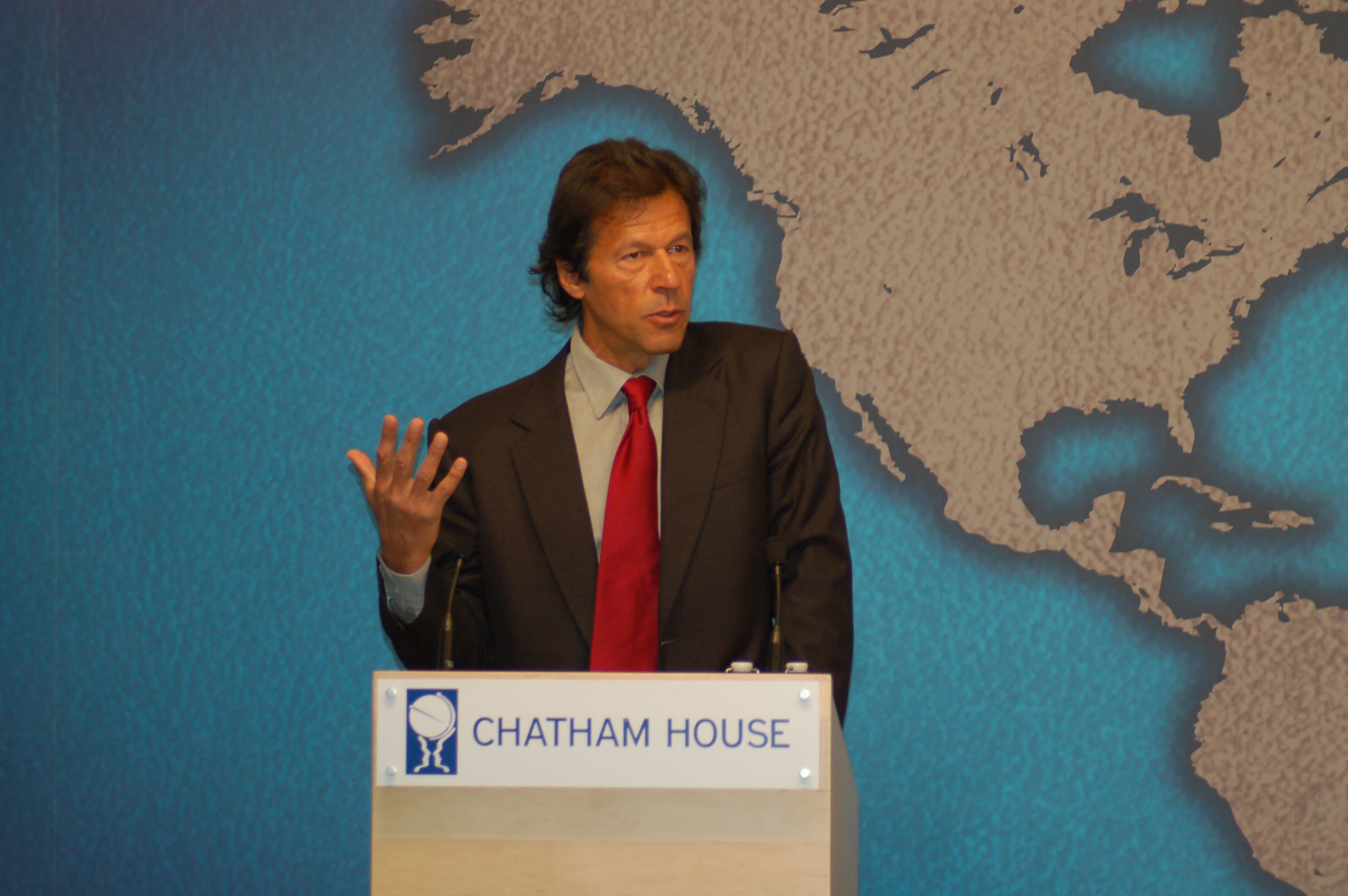
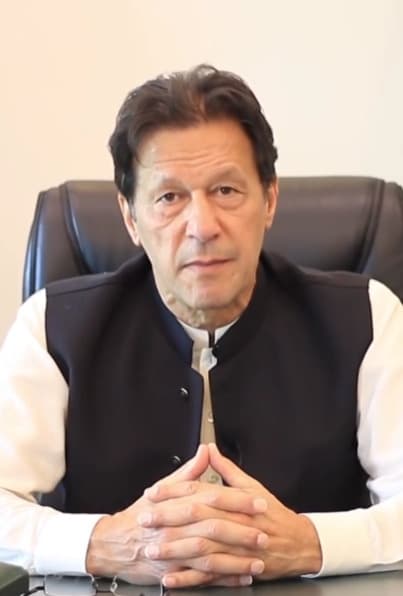
Imran Khan — cricketer, philanthropist, and 22nd Prime Minister of Pakistan.Wikimedia Commons · CC BY-SA 4.0
Khan was educated at Aitchison College in Lahore, then at the Royal Grammar School Worcester in England, and later at Keble College, Oxford, where he read Philosophy, Politics, and Economics. But it was on the cricket pitch, not in the lecture hall, where he would first make his mark on history.
He debuted for the Pakistan national cricket team in 1971, at the age of eighteen. The early years were unremarkable. He was a medium-pace bowler with raw talent but inconsistent form. It was during the late 1970s and early 1980s that Khan transformed himself into one of the most devastating fast bowlers the sport had ever seen — a conversion that coincided with his growing maturity as a leader.
In 1982, he was appointed captain of the Pakistan cricket team. He would hold that role, with interruptions, for a decade.
The World Cup
The defining moment came in 1992, in Melbourne, Australia. Pakistan had stumbled through the group stages of the Cricket World Cup, losing matches they should have won, looking disorganized and demoralized. They were, by most accounts, on the verge of elimination.
Khan rallied the team. The story of what followed has been told so many times in Pakistan that it has taken on the quality of national myth — but the facts are straightforward. Pakistan won their remaining group matches, beat New Zealand in the semifinal, and then, on March 25, 1992, defeated England in the final at the Melbourne Cricket Ground.
Khan scored 72 runs in the final and took the crucial wicket that turned the match. He was thirty-nine years old. He lifted the trophy and announced his retirement from international cricket.
In Pakistan, he was no longer just an athlete. He was a symbol. The man who had done the impossible.
Khan fundraising for the Shaukat Khanum Memorial Cancer Hospital in Jeddah (1992) — channelling his World Cup fame into building Pakistan's first cancer hospital.Wikimedia Commons · Public Domain
You have to believe in the impossible to achieve it.
That belief — critics would later call it stubbornness, or narcissism, or messianic delusion — would define everything that came after.
The Philanthropist
Khan did not immediately enter politics. Instead, he turned to philanthropy, driven by a deeply personal tragedy. His mother, Shaukat Khanum, had died of cancer in 1985. The experience of watching her suffer, and of seeing the inadequacy of cancer treatment available to ordinary Pakistanis, left a lasting impression.
In 1994, two years after the World Cup victory, Khan opened the Shaukat Khanum Memorial Cancer Hospital and Research Centre in Lahore. It was Pakistan's first specialized cancer hospital, and it was built almost entirely on public donations — many of them collected by Khan personally, drawing on the enormous goodwill he had accumulated as a cricketing hero.
The hospital was, and remains, a remarkable achievement. It provides free treatment to approximately 75 percent of its patients. It has since expanded to a second campus in Peshawar, opened in 2015. By any measure, it is one of the most successful charitable institutions in Pakistan's history.
Khan's philanthropic work extended to education. In 2008, he established Namal University (originally Namal College) in Mianwali, his ancestral district — one of the poorest and most underdeveloped regions of Punjab. The institution was designed to bring quality higher education to students who would otherwise have no access to it. It has since been upgraded to a full university and continues to operate.
These were not vanity projects. They were serious, sustained, and effective. And they gave Khan something that no amount of political maneuvering could have manufactured: credibility with ordinary Pakistanis.
The Politician
Khan founded the Pakistan Tehreek-e-Insaf (PTI) — the Movement for Justice — on April 25, 1996. The name was a statement of intent. Pakistan's political landscape was dominated by two dynastic parties: the Pakistan Muslim League-Nawaz (PML-N), led by Nawaz Sharif, and the Pakistan Peoples Party (PPP), led by the Bhutto family. Both had governed. Both had been accused of corruption. Both had been removed by the military. And both had come back.
Khan's pitch was different. He ran on an anti-corruption platform. He promised to end dynastic politics, to build a welfare state modeled on the early Islamic caliphate of Medina, and to pursue an independent foreign policy that would free Pakistan from its decades-long dependence on the United States.
For twenty-two years, nobody listened.
PTI won one seat in the 2002 general elections — Khan's own. In 2008, the party boycotted the elections entirely. Khan was dismissed by Pakistan's political establishment as a naif, a dilettante, a cricketer who had wandered into the wrong arena.
The turning point came on October 30, 2011, when PTI held a massive rally at Minar-e-Pakistan in Lahore. Hundreds of thousands of people attended. The crowd was young, urban, educated — a demographic that had never before been mobilized in Pakistani politics. Khan called it a "tsunami" — and the word stuck. PTI became the Tsunami party.
Khan campaigns in Sindh (2017), wearing a traditional Sindhi cap and Ajrak — reaching across Pakistan's diverse regions ahead of the 2018 election.Wikimedia Commons · CC BY-SA 4.0
In the 2013 elections, PTI emerged as the third-largest party in the National Assembly. It was a breakthrough, but not a victory. Khan alleged widespread rigging and spent much of the next five years protesting the results, staging sit-ins, and building his party's organizational base.
Then came 2018.
The Prime Minister
The 2018 general elections were held on July 25. PTI won 149 seats in the National Assembly, the largest share of any party, and formed a coalition government with smaller parties and independents. On August 18, 2018, Imran Khan was sworn in as the 22nd Prime Minister of Pakistan.
He was sixty-five years old. He had spent more than two decades in the political wilderness. His critics said the military had engineered his victory — that the powerful Pakistan Army, under Chief of Army Staff General Qamar Javed Bajwa, had quietly pressured electables to join PTI and had ensured that the opposition was weakened before election day.
Khan denied this. His supporters pointed to the genuine popular enthusiasm that had carried PTI to power. The truth, as usual in Pakistan, likely contained elements of both narratives.
Khan takes the oath of office as Pakistan's 22nd Prime Minister, with President Mamnoon Hussain presiding — 18 August 2018.Wikimedia Commons · Government of Pakistan
As Prime Minister, Khan pursued an ambitious agenda. He launched the Ehsaas Program, a social safety net targeting the poorest households. He championed the Billion Tree Tsunami, an environmental reforestation initiative that drew international praise. He sought to reform Pakistan's tax system, expand health insurance coverage, and reduce the country's crippling dependence on foreign debt.
On foreign policy, he was outspoken. He criticized the United States' conduct of the war in Afghanistan. He sought closer ties with China, deepened Pakistan's relationship with Turkey, and maintained what he described as a balanced approach to the Middle East — refusing to take sides in the Saudi-Iran rivalry.
It was this insistence on foreign policy independence — particularly the refusal to align automatically with Washington — that would set the stage for everything that followed.
The Moscow Visit
Twenty-Three Years
No Pakistani head of government had visited Moscow in twenty-three years. The last such visit was by Prime Minister Nawaz Sharif in 1999 — a trip that was largely ceremonial and produced no significant outcomes. In the intervening decades, Pakistan's relationship with Russia had been defined by distance, mutual suspicion, and the long shadow of the Cold War, during which Pakistan had been a key American ally against the Soviet Union.
By 2021, the geopolitical landscape had shifted. Russia was looking to expand its influence in South Asia. Pakistan was looking to diversify its energy imports and reduce its dependence on any single great power. Conversations between Islamabad and Moscow had been building for months.
The visit was planned well in advance. Diplomatic groundwork was laid through multiple channels. The agenda was focused on trade, energy cooperation, and wheat imports — practical matters of economic interest, not grand strategic realignment.
The date was set for February 23-24, 2022.
The Day Everything Changed
Khan arrived in Moscow on February 23, 2022. He was accompanied by Foreign Minister Shah Mahmood Qureshi, Information Minister Fawad Chaudhry, and a delegation of senior officials.
On February 24, 2022 — the day Khan met with Russian President Vladimir Putin at the Kremlin — Russia launched its full-scale military invasion of Ukraine.
The timing was, by any reasonable assessment, coincidental. The visit had been planned months before anyone outside the Kremlin's innermost circle knew the invasion date. Pakistani officials had no advance knowledge of Russia's military plans. But in the world of geopolitical optics, coincidence does not matter. Perception does.
The image was devastating: the Prime Minister of Pakistan sitting across from Vladimir Putin in the Kremlin on the very day Russian tanks rolled into Ukraine. It was broadcast on every news channel in the world. And it was watched very carefully in Washington.
"Absolutely Neutral"
Khan's response to the invasion was, by the standards of American expectations, defiant.
He refused to condemn Russia's attack on Ukraine. He did not join the chorus of Western leaders calling for sanctions, isolation, or military support for Kyiv. Instead, he described Pakistan's position as "absolutely neutral" — a stance that was consistent with Pakistan's historical approach to conflicts outside its immediate region, but one that, in the charged atmosphere of February 2022, was read by Washington as a provocation.
Pakistan would not be anyone's hired gun.
That phrase — "hired gun" — became the defining quote of the crisis. Khan had used it before, in reference to Pakistan's role in the American war in Afghanistan, where Pakistan had lost tens of thousands of lives and spent billions of dollars supporting US operations, only to be accused by Washington of not doing enough. The phrase carried decades of accumulated resentment.
But context matters. Khan said it at a moment when the United States was building the most comprehensive international coalition since the Gulf War — a global front to isolate Russia economically, diplomatically, and strategically. Every country was being asked to pick a side. Khan's refusal to do so was not merely a diplomatic annoyance. In Washington's view, it was a strategic defection.
The Stakes
Why did this matter so much?
Pakistan is not a minor player in global affairs. It is a nuclear-armed state with a population of over 220 million people. It is a key member of the Organisation of Islamic Cooperation. It has a seat at tables that matter. When Pakistan refuses to join a coalition, the absence is noticed.
Moreover, Pakistan had a long and complicated relationship with the United States — one built on decades of military cooperation, intelligence sharing, and financial assistance. The US had provided Pakistan with billions of dollars in military aid. It had designated Pakistan a Major Non-NATO Ally. The relationship was transactional, often bitter, and deeply unequal — but it was real, and it carried expectations.
Khan was, in Washington's assessment, violating those expectations at the worst possible moment.
The question was: what would Washington do about it?
The most consequential lunch in recent Pakistani diplomatic history took place on March 7, 2022 — eleven days after the Moscow visit — at the United States Department of State in Washington, D.C.
On the American side of the table sat Donald Lu, the Assistant Secretary of State for South and Central Asian Affairs, and Lesslie Viguerie, a senior State Department official. Lu was a career diplomat with extensive experience in South Asia. He was known for being direct.
On the Pakistani side sat Ambassador Asad Majeed Khan, Pakistan's envoy to the United States, along with other embassy officials.
The meeting was, in form, a routine diplomatic lunch — the kind that takes place hundreds of times a year between State Department officials and foreign ambassadors. But the substance was anything but routine.
What Was Said
According to the diplomatic cable that Ambassador Asad Majeed Khan sent to Islamabad after the meeting — the document that would become known as "the cipher" or Cypher No. I-0678 — Donald Lu raised the subject of Imran Khan's Moscow visit directly.
Lu described Pakistan's position on the Russia-Ukraine conflict as "aggressively neutral" — a phrase that, in diplomatic language, was several steps beyond a complaint. It was a characterization of Pakistan as an active obstacle to American interests.
Then came the statement that would shake Pakistani politics to its foundations.
According to the cipher, Lu told the Pakistani ambassador that a no-confidence motion was expected to be filed against Prime Minister Imran Khan in the National Assembly. And if that motion succeeded — if Khan was removed from power — then, in Lu's words, "all will be forgiven" by Washington.
If the motion failed, Lu warned, Pakistan would face "isolation" and consequences.
If the no-confidence vote succeeds, all will be forgiven in Washington.
The implications were staggering. A senior American diplomat was, according to the Pakistani ambassador's own contemporaneous account, linking Pakistan's domestic political outcome to the United States' diplomatic posture. He was saying, in effect: remove your Prime Minister, and we will reward you. Keep him, and we will punish you.
The Cable
Ambassador Asad Majeed Khan drafted a diplomatic cable — a cipher, in Pakistani diplomatic terminology — and transmitted it to the Ministry of Foreign Affairs in Islamabad through secure channels. The cable, designated Cypher No. I-0678, arrived at the Foreign Ministry and was forwarded to the Prime Minister's Office.
This is not disputed. The existence of the cipher, its transmission, and its receipt by the Pakistani government are matters of documented record. What has been disputed — fiercely, bitterly, and with enormous political consequences — is what the cipher means.
Khan's reading was unambiguous: this was evidence of a foreign conspiracy to remove him from power. The United States, angered by his Moscow visit and his refusal to condemn Russia, had signaled to Pakistan's political and military establishment that it wanted Khan gone — and that there would be rewards for compliance.
The State Department's response was equally unambiguous: the characterization was false. The US denied threatening Pakistan. It denied conditioning its relationship on Khan's removal. It described the meeting as a routine diplomatic exchange in which concerns were raised — as concerns are always raised — and nothing more.
The Intercept Publication
For more than a year, the cipher remained classified. Its contents were described by Khan and his allies in public speeches and press conferences, but the actual text was not available for independent verification.
That changed on August 9, 2023, when The Intercept, an American investigative news outlet, published what it described as the full text of the cipher.
The publication was significant for several reasons. First, it confirmed the basic facts that Khan had been describing: that a meeting had taken place, that the Moscow visit had been raised, that the phrase "all will be forgiven" had been used, and that the language carried an unmistakable implication of conditionality.
Second, it provided the international press with a primary source document — not Khan's interpretation, not the State Department's denial, but the actual words written by Pakistan's own ambassador in real time.
Third, it complicated the narrative that Khan was fabricating a conspiracy theory. Whatever one made of the cipher's implications, the document itself was real, and its contents were troubling.
The Intercept's reporting noted that the cipher was consistent with a pattern of American diplomatic behavior in which US officials expressed preferences about the domestic politics of allied nations — not through explicit orders, but through signals, incentives, and the careful calibration of consequences.
The cipher became the most debated document in Pakistani politics since the country's founding. Opinions divided along predictable lines.
Khan's supporters saw it as a smoking gun — proof that the United States had orchestrated a regime change operation against a democratically elected Prime Minister who had dared to pursue an independent foreign policy. They compared it to the CIA's history of covert interventions in Latin America, the Middle East, and Southeast Asia.
Khan's opponents offered a different reading. The cipher, they argued, was a routine diplomatic communication that recorded a frank exchange of views. Donald Lu had expressed displeasure — as American officials often did — but had not issued an ultimatum. The no-confidence motion, they insisted, was driven by domestic factors: Khan's deteriorating relationship with the military, his loss of coalition allies, and his government's economic mismanagement.
The truth, as with so many things in this story, depends on how much weight you give to documented words versus claimed intentions.
But one fact was beyond dispute: the day after the cipher was sent to Islamabad, the no-confidence motion was filed in Pakistan's National Assembly.
The No-Confidence Vote and Removal
Forty-Five Days
The period between the filing of the no-confidence motion and Imran Khan's removal from power lasted approximately forty-five days. It was the most turbulent, constitutionally fraught, and politically consequential period in Pakistan's recent history — and that is saying something for a country that has experienced four military coups, the assassination of two heads of state, and the judicial execution of a Prime Minister.
Here is how it unfolded.
March 8, 2022
No-Confidence Motion Filed
The combined opposition — led by the Pakistan Muslim League-Nawaz (PML-N), the Pakistan Peoples Party (PPP), and the Jamiat Ulema-e-Islam-Fazl (JUI-F) — filed a no-confidence motion against Prime Minister Imran Khan in the National Assembly. The motion required the signatures of at least 68 members to be submitted and 172 votes to succeed. The opposition claimed it had the numbers.
March 8-28, 2022
The Horse-Trading Begins
What followed was a period of intense political maneuvering that Pakistanis euphemistically call "horse-trading." Both sides worked furiously to secure votes. The opposition courted PTI's coalition partners — smaller parties and independent members who had joined Khan's government after the 2018 elections but whose loyalty was, as always in Pakistani politics, conditional. Khan's team fought to hold the coalition together. Allegations of bribery, intimidation, and backroom deals flew in both directions. Several PTI members began publicly distancing themselves from the Prime Minister.
March 27, 2022
Khan Addresses the Nation
Imran Khan held a massive public rally in Islamabad and, for the first time, publicly revealed the existence of the cipher. He waved a piece of paper before the crowd — describing it as evidence of a foreign conspiracy against his government. He named no country directly at the rally, but his meaning was unmistakable. He framed the no-confidence motion as an American-backed plot to punish Pakistan for its independent foreign policy and, specifically, for the Moscow visit. The crowd roared. But inside the National Assembly, the numbers were moving against him.
April 3, 2022
The Deputy Speaker's Ruling
The no-confidence motion was scheduled for a vote in the National Assembly on April 3. In a dramatic and legally extraordinary move, Deputy Speaker Qasim Khan Suri — a PTI loyalist — dismissed the no-confidence motion without allowing a vote. He ruled that the motion was part of a foreign conspiracy and was therefore unconstitutional under Article 5 of the Constitution, which prohibits actions prejudicial to state sovereignty. Minutes later, President Arif Alvi — on the advice of Prime Minister Khan — dissolved the National Assembly and called for new elections.
April 7, 2022
The Supreme Court Intervenes
Pakistan's Supreme Court, in a unanimous decision by a five-member bench headed by Chief Justice Umar Ata Bandial, declared the Deputy Speaker's ruling unconstitutional. The court ruled that the dissolution of the National Assembly was illegal and void. It ordered the Assembly to be reconvened and the no-confidence vote to proceed. The ruling was unambiguous: the Constitution required that a no-confidence motion, once properly submitted, must be put to a vote. No constitutional provision allowed a presiding officer to dismiss such a motion on the grounds of an alleged foreign conspiracy.
April 9, 2022
The Night Session
The National Assembly reconvened on the night of April 9 for the no-confidence vote. The session was tense, chaotic, and — in a pattern familiar to observers of Pakistani parliamentary proceedings — lasted well past midnight. PTI members, following Khan's instructions, resigned from the Assembly en masse before the vote. Khan had decided that his party would not participate in what he called an illegitimate process. The opposition, undeterred, pressed forward.
April 10, 2022
The Vote — Khan Removed
In the early hours of April 10, 2022, the no-confidence motion was put to a vote. It passed with 174 votes in favor — two more than the 172 required. Imran Khan became the first Prime Minister in Pakistan's history to be removed through a parliamentary no-confidence vote. He had been in office for three years, seven months, and twenty-three days.
The Army's Role
No account of Khan's removal is complete without addressing the role of the Pakistan Army — the institution that has been the ultimate arbiter of political power in the country since its founding in 1947.
Khan had come to power in 2018 with the military's tacit support. His relationship with General Qamar Javed Bajwa, the Chief of Army Staff, was initially cooperative. But by late 2021, that relationship had deteriorated sharply.
The reasons were multiple. Khan had resisted Bajwa's preferred candidate for the position of ISI (Inter-Services Intelligence) chief. There were disagreements over the handling of the Tehrik-i-Taliban Pakistan (TTP) insurgency. And there was a growing sense within the military establishment that Khan's confrontational style — his public airing of the cipher, his accusations against the United States — was damaging Pakistan's most critical international relationships.
Prime Minister Imran Khan with Foreign Minister Shah Mehmood Qureshi and Army Chief General Qamar Javed Bajwa — a civil-military relationship that collapsed under the weight of 2022's political crisis.Wikimedia Commons · Government of Pakistan
When the no-confidence motion was filed, the Army took a position of what it called "neutrality" — a word that, in the context of Pakistani civil-military relations, is never neutral. When the military says it is staying out of politics, it is making a political statement. In this case, the statement was clear: the Army would not intervene to save Khan.
For Khan, this was the decisive betrayal. He had believed — or claimed to believe — that the military would stand with him against what he described as a foreign-backed conspiracy. Instead, the military withdrew its support, and with it went the last pillar holding up his government.
I will not accept an imported government.
After the Vote
Shehbaz Sharif, the younger brother of three-time Prime Minister Nawaz Sharif and leader of the PML-N, was elected as the new Prime Minister on April 11, 2022. He inherited an economy in crisis, a divided nation, and the unresolved question of the cipher.
In a revealing postscript, the National Security Committee (NSC) — Pakistan's highest civil-military security body — met under Shehbaz Sharif's government and reviewed the cipher. According to multiple reports, the committee acknowledged that the contents of the cipher were accurate — that the meeting had taken place, that the language attributed to Donald Lu had been used, and that the communication reflected genuine American displeasure.
However, the NSC concluded that the cipher did not constitute evidence of a conspiracy — that there was a difference between a foreign government expressing displeasure and a foreign government orchestrating a regime change. The distinction was, to Khan's supporters, a distinction without a difference.
The committee's findings were never made fully public. The new government moved to classify the cipher and initiated legal proceedings against Khan for publicly disclosing a classified diplomatic document — a charge that would contribute to one of the many criminal cases filed against him in the months that followed.
A Pattern
One final fact deserves attention, because it provides context that is often overlooked in the heat of partisan debate.
No Pakistani Prime Minister has ever completed a full five-year term. Not Liaquat Ali Khan, who was assassinated. Not Zulfikar Ali Bhutto, who was executed. Not Nawaz Sharif, who was removed three times. Not Benazir Bhutto, who was dismissed twice and later assassinated. Not Yousaf Raza Gillani, who was disqualified by the Supreme Court. And not Imran Khan, who was removed by a no-confidence vote.
Pakistan's political history is a history of interrupted mandates. The methods have varied — military coups, judicial interventions, assassinations, and now, a parliamentary no-confidence motion backed by a realignment of political and military forces. But the pattern is consistent: power in Pakistan is never held securely, and it is never surrendered willingly.
Khan's removal fits this pattern. What makes it distinctive is the documented evidence of foreign involvement — not proof of a conspiracy, perhaps, but proof of a preference, expressed at a specific moment, through specific channels, with specific consequences.
The cipher exists. The words were spoken. The vote followed.
What you make of the connection between these facts is, ultimately, a question of judgment. But the facts themselves are not in dispute.
Where It Stands
Since his removal, Imran Khan has faced a cascade of legal proceedings. He has been arrested, released, re-arrested, and imprisoned on charges ranging from corruption to the disclosure of state secrets to incitement of violence related to the events of May 9, 2023, when PTI supporters attacked military installations following one of Khan's arrests.
Khan speaks to media at his own Shaukat Khanum hospital after surviving an assassination attempt in November 2022 — shot in the leg during a protest march to Islamabad.Wikimedia Commons · CC BY-SA 4.0
His party has been subjected to a sustained campaign of legal and political pressure. Senior PTI leaders have been arrested, have defected, or have gone into hiding. The party's election symbol — the cricket bat — was stripped by the Election Commission ahead of the February 2024 elections.
Despite all of this, PTI-backed independent candidates won the largest share of National Assembly seats in the February 8, 2024 elections — a result that stunned the political establishment and demonstrated that Khan's support base, far from being diminished by his imprisonment, had only hardened.
Khan remains, as of this writing, the most popular political figure in Pakistan. He remains in detention. And the cipher remains at the center of an unresolved national argument about sovereignty, democracy, and the price of independence.
A country that sells itself to others can never prosper.
Sources and Further Reading
The following sources informed this timeline and are recommended for readers seeking to verify claims or explore the story further:
This is a living document. As new information becomes public — through court proceedings, declassified communications, or investigative reporting — this timeline will be updated accordingly.
The facts are the foundation. The interpretation is yours.